


German trade tax: Minimum municipal multiplier of 280% from 2027
Tax changes may appear technical at first, but they can have very tangible financial consequences for businesses. The new minimum German trade-tax multiplier is a case in point: from 2027, a minimum rate of 280% will apply throughout Germany. Below, we provide a concise overview of what is changing, who will be affected and where an early review may be advisable.
What is changing?
The Ninth Act Amending Provisions in Tax Advisory Law and Tax Law, dated 29 June 2026 (Federal Law Gazette 2026 I No. 197), introduces a nationwide minimum municipal multiplier of 280% for German trade tax under Section 16(4) of the German Trade Tax Act (GewStG).
The new rule will apply for the first time to the 2027 assessment period.
Financial impact
German trade tax is calculated using the following formula:
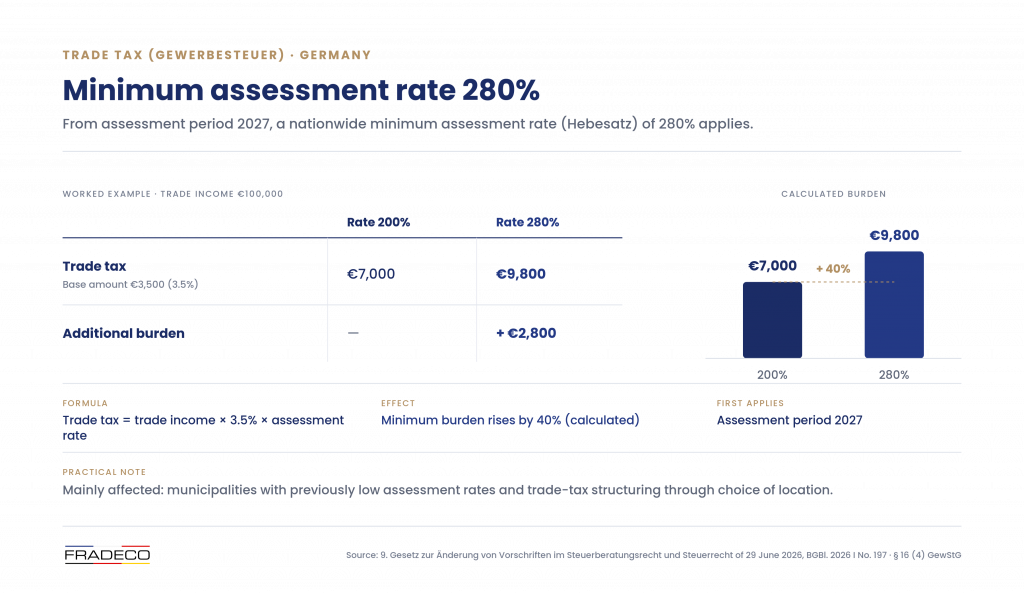
Trade tax = trade income × 3.5% assessment rate × municipal multiplier
The following example illustrates the effect:
| Basis of calculation | Multiplier of 200% | Multiplier of 280% |
| Trade income | EUR 100,000 | EUR 100,000 |
| Tax assessment amount | EUR 3,500 | EUR 3,500 |
| Trade tax | EUR 7,000 | EUR 9,800 |
| Additional tax burden | – | EUR 2,800 |
In municipalities that have previously applied a multiplier below 280%, the minimum tax burden will therefore increase by up to 40% in mathematical terms.
Who will be particularly affected?
The new rule will primarily affect:
- Businesses located in municipalities that have previously applied low multipliers. These are often structurally weaker or rural regions that have used low rates to attract businesses.
- Companies whose choice of location has also been motivated by tax considerations, particularly traditional trade-tax arrangements involving municipalities with low multipliers.
Our assessment
We recommend that clients with permanent establishments in municipalities applying low multipliers review the impact on their tax burden from 2027 at an early stage. This should be considered particularly as part of liquidity and tax planning and when making upcoming location decisions.
Existing arrangements based on the municipal multiplier should also be reviewed, as the associated tax advantage will be significantly reduced from 2027 and may, in some cases, cease to apply entirely.
We would be pleased to discuss how the new rule will affect your company and whether any action is required.
Source: Ninth Act Amending Provisions in Tax Advisory Law and Tax Law of 29 June 2026, Federal Law Gazette 2026 I No. 197 (Section 16(4) GewStG; first applicable to the 2027 assessment period).
If you have further questions, our accountants will be happy to provide you with personal advisory. Additionally, we are available to advise you throughout France and Germany by phone and video conference. Your Franco-German tax consultancy FRADECO.
Disclaimer
Although the greatest possible care has been taken in the preparation of this newsletter, we reserve the right to make changes, errors, and omissions. The abstract legal presentation in this newsletter is no substitute for individual civil and tax law advice on a case-by-case basis. Subsequent changes to the legal framework, the views of the German or French tax authorities or case law, including with retrospective effect, are possible.


